 I love language and accents, and I have an ear for dialects that can vary by region, town, and sometimes even neighborhood. If I hear an accent from North Carolina, I can usually get a fairly precise idea of where in the state that person grew up.
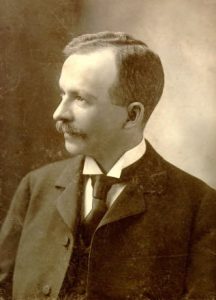
When I read Charles W. Chesnutt’s novel The House Behind the Cedars, a novel written in Cleveland but set in North and South Carolina, I didn’t hear dialect so much as familiar cadences and settings. Chesnutt was an African-American writer in the late 19th century who was born in Cleveland to “free persons of color” who then returned to their home region of the sandhills of North Carolina. Chesnutt returned to Cleveland, where he built a life as a writer, lawyer, intellectual, and activist.
Chesnutt was of “mixed race.” His ancestry was overwhelmingly white, and yet he chose to embrace his African-American heritage. His novels and stories are rich with plotlines and tensions that emerge from this, charting the divisions and ambiguities of race in the post-Civil War South.
In The House Behind the Cedars, which takes place just after the end of the War, the main character—a man who keeps his mixed-race identity hidden—hears his sister speak with an older African-American woman with a much stronger dialect:
The sound of (his sister’s) voice gave Warwick a thrill. It was soft and sweet and clear—quite in harmony with her appearance. That it had a faint suggestiveness of the old woman’s accent can hardly be noticed, for the current Southern speech, including his own, was rarely without a touch of it.
Chesnutt continues that “The corruption of the white people’s speech was one element” of unconscious comeuppance for what African Americans have been forced to endure under the enslavement economy and the Jim Crow regime that followed it.
That particular vision of post-Civil War North Carolina, and the dynamic tensions around race, language, and status, is a new perspective for me, even though I grew up surrounded by variations of the Southern accent Chesnutt describes. And in a curious irony, it’s only through a uniquely Cleveland author that I have experienced it.
This Sunday, as we also celebrate Union of Black Episcopalians Sunday (as well as launching our Stewardship Campaign), I will welcome scholar and community leader Dr. Regennia Williams to the Dean’s Forum to talk about Charles Chesnutt. We’ll also have guests from St. Andrew’s Episcopal Church and the Rowfant Club with us at the forum and at the 11:15 service, as the celebration of Chesnutt’s work and Williams’ Praying Grounds Oral History Project will continue at Trinity after our Sunday services.
I look forward to a joyful Sunday with you!
Faithfully,