
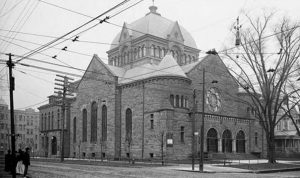
Photo from the Cleveland Restoration Society
Cleveland is home to so many majestic houses of worship, many faded and some abandoned, that one can pass by them every day without much thought beyond flashes of curiosity about their stories and the people who worshiped within them.
Soot-stained and empty since 2014, the Friendship Baptist Church was one such building. I often passed in on my way to the cathedral when my route took me through Cleveland’s Central neighborhood. Even without knowing its history, I could see that Friendship was a faded beauty that spoke of a different era, an abandoned treasure sitting at the heart of a city that has changed in the century-and-a-quarter since the church was built.
Friendship burned to the ground on Friday, intentionally set on fire by an arsonist, and even though the congregation had since moved out and merged with another, the absence created by the sudden loss at the intersection of East 55th and Central rings with a silence that simply breaks your heart.
This history of Friendship is a picture of Cleveland’s vital congregations, a story not just of religion but of a dynamic ebb and flow that carries the hearts and stories of many thousands of faithful people. Like so many of our treasured sanctuaries, it started life as something else. It was built in 1894 as Tifereth Israel Synagogue, one of several gathering places for the strong Jewish population on Cleveland’s east side. The congregation moved farther east, and the grand synagogue was bought by Mt. Zion Congregational Church and ultimately by Friendship Baptist Church in 1940, becoming a pillar of the Black community in the Central Neighborhood, and even a vital hub in the Civil Rights Movement. Martin Luther King, Jr. spoke there on May 14, 1963, shortly after being released from jail in Birmingham, Alabama.
The story of congregational and neighborhood decline is familiar to many congregations across the country, and in the Rust Belt we feel it acutely. Some congregations have closed, and others have taken the “conveyor belt” to the suburbs and are doing fine (or sometimes not). But these downtown churches are more than just faded architectural gems: they hold in their brick and mortar generations of prayer and praise, weddings and funerals, and sermons and movements that have reverberated globally. Years of prophetic preaching and Negro spirituals have settled like holy dust over a base of Hebrew prayers, a singular stratigraphic layering of holiness and communal life that now only exists in memory.
The story of this building, now lying in ruins, is that of the thousands of faithful people who called the sanctuary home over a century of witness and change, and of neighbors who have looked to the church and called it theirs.
Congregations move on and fade, and neighborhoods ebb and flow. That will never stop. Yet the resonance of prayer and devotion remains in these spaces long after the last song is sung, and some even have a second life beyond that. Not all churches are meant to stand for centuries, but so long as they do, they carry an imprint of our collective souls.
This is an abbreviated version of my blog post for Cathedral of the Heart. You can read the longer version online.
Faithfully,