
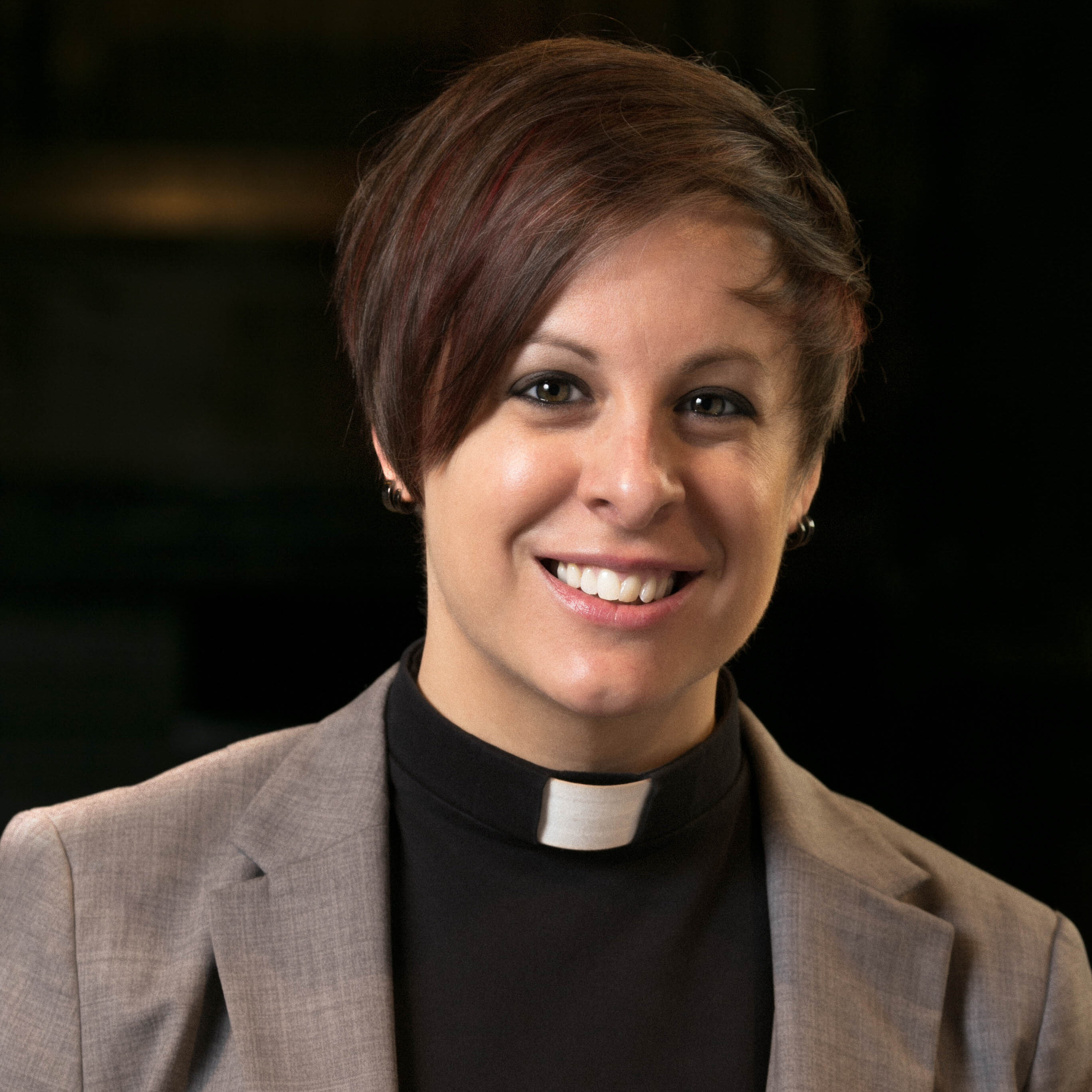
Learn more about the Rev. Canon Adrienne Koch and her work at Trinity, where she helps with the behind-the-scenes planning that brings worship to life.
Q: Can you share a bit about your background and your role at Trinity?
I was born in Cleveland and lived in the area most of my life. I left for North Carolina for graduate school and lived in the Raleigh/Durham area for 11 years, and then returned to be a priest at Trinity. I was drawn to Trinity because of the robust LGBTQ community here and felt called to “big system” thinking work, without forfeiting the pastoral care common in a parish setting. The cathedral gave me the best of both worlds. I’ve been here for nearly 7 years now, and I love my job and the community at Trinity.
Q: What is involved in your role as Canon at Trinity?
As a canon, I am tied to the leadership in the bishop’s office, with the role as Diocesan Liturgist, and I also work closely with the dean on strategic work at Trinity. “Canon” simply means “rule,” and it’s a term that signifies elder leadership in a diocesan structure. As the liturgist, I collaborate with clergy and laypeople across the diocese to plan church services throughout the northern half of Ohio. As the Canon for Mission and Transformation at Trinity, I am the staff person responsible for the Cathedral Ministries Vestry Committee, which oversees the Mission Teams (unelected lay leadership) and Cathedral Circles (small groups) at Trinity. I also organize Faith Formation/Education opportunities and oversee the “behind the scenes” of liturgy production: worship volunteers, training, process, strategy, etc.
Q: What does preparation for worship typically look like behind the scenes?
With the formation of the Liturgy Mission Team has come a huge restructure of the way we use the back-end electronic system for worship volunteers known as Ministry Scheduler Pro (MSP). MSP is the calendaring and communication program that organizes data for our current list of 150 worship volunteers. These volunteers cover multiple weekly services on Sundays, as well as seasonal services on Wednesdays, special services throughout the year, and a monthly Solemn Eucharist. It takes around 20 volunteers to put on one regular Sunday eucharist, and more than 30 for a special service like Christmas or Easter. This doesn’t even include the flower guild, which comes in the day before events to make the nave creatively beautiful each season and service. Volunteers like vergers and sacristans come in very early (sometimes before facilities open the front doors!) to prepare the space for worship, as do coffee-hour volunteers. About 15 minutes before the service, the sacristy (where Eucharistic elements are prepared and cleaned) and the vesting room (where clergy and volunteers put on robes) are buzzing with volunteers checking in and pre-setting items needed for the service, like a stand for the processional cross, or to make sure the right pages in the altar book are bookmarked. Some services, like Easter Vigil, require a two-hour dress rehearsal, as well as multiple staff/volunteer/clergy walkthroughs in the weeks prior.
Q: What role does the Liturgy Mission Team play in shaping our worship services?
The Liturgy Mission Team is responsible for creating and editing customaries. Customaries are detailed guides outlining the specific liturgical, sacramental, and operational practices of a faith community, adapting broader tradition to local contexts. They include instructions for services, clergy and lay roles, and decorum, ensuring the consistency, conformity, and creativity that the Episcopal Book of Common Prayer invites. This team plans to meet monthly to continue the work of creation, maintenance, and volunteer morale that liturgy constantly requires. Together we oversee four Sunday services (8:00 a.m., 9:00 a.m., 11:15 am, and a combined 10:00 a.m. in the summer), two weekly services (Evensong and Healing Eucharist), one monthly service (Solemn Sung), and a smattering of special services throughout the year, you know, small ones, like Christmas Eve and Easter Vigil!
Q: What kinds of gifts, interests, or skills are helpful for someone who wants to get involved with the liturgy team?
Great question! There are roles for introverts and extroverts alike in worship volunteering. Greeter roles are for extroverts at the front doors, welcoming everyone as they enter the space. Ushering can be for introverts who offer simple instructions (often non-verbal) to help folks move through the service elements (like how to walk up to communion).
Aptitudes like attention to detail work well for both behind-the-scenes and “in the limelight” worship roles, such as Sacristan (preparing the communion elements before the service) or Acolyte (assisting the Verger and Clergy at the table during worship). Coffee-Hour Host is a great behind-the-scenes Sunday ministry, too.
If you like public speaking or have theater experience, it’s great for praying the Intercessions or doing a Biblical Reading. Steady hands and respect for the Eucharist are all that’s needed to become a Eucharistic Minister (EM) and offer the chalice at Communion. A skill for one-on-one connection and care is needed for Eucharistic Visitors (EV) who bring Communion to the home-bound after service. A great way to get involved with the choir is to explore the summer All Y’all Choir opportunities and see what it’s like to sing the music at Trinity.
If you’d like to discover what ministries might be a good fit for you, take the Ministry Quiz on our website, then follow up with staff to get involved.
Q: Is there a moment in worship at Trinity that has especially stayed with you or felt particularly meaningful?
There is a special glow, both physically and emotionally, that occurs during the Christmas Eve service and the singing of Silent Night by candlelight. Hope, joy, and a deep abiding calm are palpable. How often does that happen in our lives?! Definitely once a year at Trinity. On a playful note, any time real flames are given to the congregation for a service, there is a fire risk that clergy always have to be on the lookout for! We have had instances of things catching on fire, as well as some close calls with people placing their candles down on table linens or kneelers without thinking! I guess we’re not used to carrying candles around for light in our culture much anymore. Bringing that candlelight tradition into worship is one of the special things about Episcopal liturgy that is both ancient and modern.
Q: How do you hope the Liturgy Mission Team continues to grow in the future?
Technically, the Liturgy Mission Team is the leadership group that oversees worship, but the Mission Team’s purview also includes all the volunteers mentioned earlier! But to speak directly to the team, I’d have to first give props to our vergers who have been HUSTLING this last year as we’ve developed new job descriptions for those roles. (Some new vergers will be trained this summer—yay!) Two vergers are currently on the committee, Darrel Lausche (who is currently verging the 11:15 a.m. service and doing great) and Ted Andrews (Ted is Trinity’s Head Verger and does a fantastic job—thanks, Ted!). The verger role is the only one that the Dean invites a person into because it requires a particular kind of personality and skill set, especially an ability to non-anxiously support others. I’m so grateful for the extra work vergers are putting into this new Liturgy Mission Team, and I hope that in a year or two, we will only need one verger on the team (to give them a break, because they work hard!) and expand the represented roles to more folks.
I’m grateful to have Choir Member Richard Pryor on the team, to edit our customaries and offer insights from communities he was connected to during his time in Divinity School. And to have the vestry rep be a long-time Trinity member and long-time Flower Guild lead, Usher, EM, and volunteer-extraordinaire, Diane Hexter. She’s a lovely example of someone who does so much behind-the-scenes work to make Trinity a special place people want to be! Shiloh Roby is our gifted Music and Choir Director (and organist/pianist, etc.) His gifts in liturgy are plentiful. This is the right team to begin the Mission Team foundational work, and I look forward to seeing how it expands to new folks and ideas in the coming years.